


Skip to content
Best Varanasi Tour Planner — Kashi Yatra

Travel Guide · Varanasi + Prayagraj + Ayodhya + Chhapaiya + Naimisharanya

Varanasi Ayodhya Prayagraj Chhapaiya Naimisharanya 4 Nights 5 Days Itinerary

A practical, day-by-day plan that carries our Golden Triangle route — Varanasi, Prayagraj and Ayodhya — on to two places most itineraries skip: Chhapaiya, the birthplace of Bhagwan Swaminarayan, and Naimisharanya, the forest where the Puranas are said to have been narrated. It is the same route our team runs as a package — follow it yourself, or hand it to us.

Before you start

Varanasi Ayodhya Prayagraj Chhapaiya Naimisharanya Itinerary Overview

This plan starts as our usual Golden Triangle — Varanasi, Prayagraj and Ayodhya — and carries it on toward Lucknow to two places most itineraries skip. Chhapaiya (also written Chapaiya or Chapiya) is a village in Gonda district, the birthplace of Bhagwan Swaminarayan, and Naimisharanya is the forest town where, Hindu tradition holds, the sage Suta Goswami narrated the Puranas to 88,000 rishis. Neither has much written about it elsewhere, so this guide leans on the same sources as our tour package for the two of them.

You spend one night each in Varanasi, Prayagraj, Ayodhya and Naimisharanya. Day 1 is the Varanasi old city and the evening Ganga Aarti, Day 2 the drive to Prayagraj and the Sangam, Day 3 the drive to Ayodhya with the full Ram Mandir darshan, Day 4 an early start for Chhapaiya followed by the long drive on to Naimisharanya, and Day 5 the Naimisharanya sites before your drop at Lucknow.

Read Day 4 carefully before you commit to this plan. Naimisharanya is a long way from the rest of the route — roughly 230 km and 5 to 6 hours of driving from Ayodhya alone, on top of the Chhapaiya stop — so it is the one day here with almost no slack. And note that this itinerary ends at Lucknow, about 90 km from Naimisharanya, not back in Varanasi; plan your onward travel from there.

Varanasi Ayodhya Prayagraj Chhapaiya Naimisharanya 4 Nights 5 Days Itinerary at a glance, by day
DayMorningAfternoonEvening
Day 1
Old city & Aarti
Arrival · Kal Bhairav → Kashi Vishwanath → AnnapurnaRest, or Vishwanath GaliBoat ride (optional) + Ganga Aarti
Day 2
Varanasi to Prayagraj
Drive (~130 km) · Lete HanumanSangam dip, Anand BhavanAllahabad Fort, check in
Day 3
Prayagraj to Ayodhya
Drive · Hanuman GarhiRam Mandir, Kanak BhawanSaryu aarti at Ram ki Paidi
Day 4
Chhapaiya & the road to Naimisharanya
Swaminarayan Mandir, ChhapaiyaLong drive toward NaimisharanyaCheck in and rest
Day 5
Naimisharanya & drop
Chakra Tirtha, Lalita Devi, Vyas GaddiDrive to Lucknow (~90 km)Drop at airport or station

Day by day

Varanasi, Prayagraj, Ayodhya, Chhapaiya and Naimisharanya Itinerary: Day-by-Day Plan

Prefer to read it all as text? Jump to the full written itinerary.

DAY1

Old-City Temples & the Evening Aarti in Varanasi

Land, check in, and give the day to the three old-city temples before the river takes over in the evening.

  1. On arrival
    Varanasi airport terminal where visitors arrive

    Check in and get your bearings

    Whether you fly into Lal Bahadur Shastri Airport or arrive by train at Varanasi Junction or Manduadih, head straight to your hotel and drop your bags. With five places to cover in five days, this trip does not leave much room for a slow start.

  2. Late morning
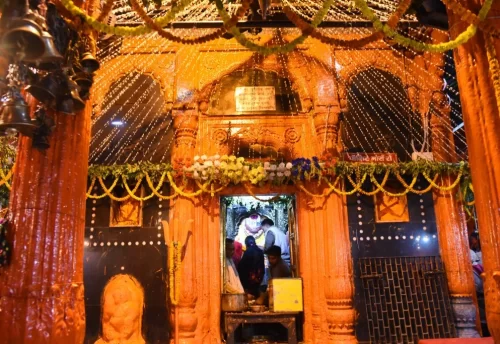
    Decorated entrance of the Kal Bhairav Temple in Varanasi

    Kal Bhairav Temple

    Local custom has visitors seek Kal Bhairav's blessing — he is considered the guardian of Kashi — before the other old-city temples. Open roughly 5:00 AM–1:30 PM and 4:30–9:30 PM; entry is free and 30–45 minutes is enough.

    A cab only gets you to the edge of the lane — the last stretch to the shrine is on foot.

  3. Late morning
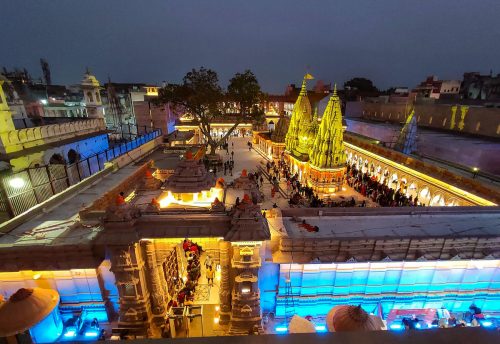
    Kashi Vishwanath Temple and its corridor lit up at night, Varanasi

    Kashi Vishwanath Temple

    The present temple was built in 1780 and is reached today through the Kashi Vishwanath Corridor, opened in December 2021. Phones and cameras are not allowed inside, so leave yours at the hotel or use a locker.

    Budget 1.5–3 hours depending on the queue. Mondays and the month of Shravan are the busiest.

  4. Midday
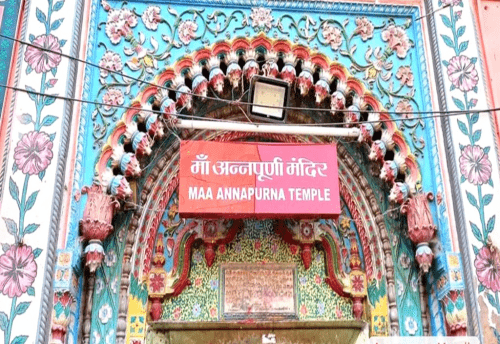
    The decorated entrance arch of the Annapurna Temple in Varanasi

    Annapurna Temple

    A two-minute walk from Vishwanath. Published hours are roughly 4:00–11:30 AM and 7:00–11:00 PM, so it is closed for much of the afternoon — arriving here late morning avoids a second trip in the evening.

  5. Afternoon
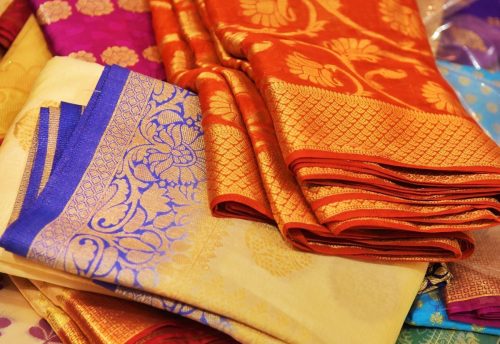
    Colourful Banarasi silk sarees in a Varanasi market

    Rest, or a walk through Vishwanath Gali

    Three temples on foot in old-city heat is enough for most people. Head back to the hotel, or browse Vishwanath Gali and the Godowlia market for Banarasi silk — there is no obligation to buy anything.

  6. Evening, optional
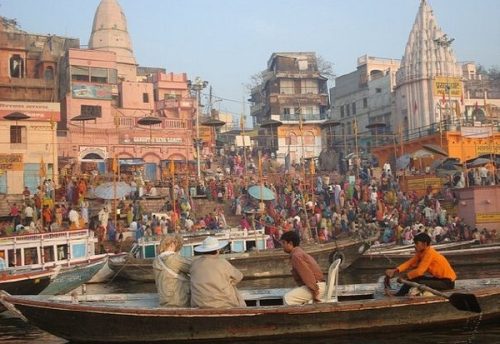
    A rowing boat among the crowded ghats of Varanasi

    A boat ride before the aarti

    Not essential, but worth the extra if you have the time. Boats leave from ghats such as Assi, Dashashwamedh, Namo and Kedar, and watching the aarti from the water beats the crowded steps.

    Agree the fare before boarding if you are hiring one on the spot, or book ahead through us.

  7. Around dusk
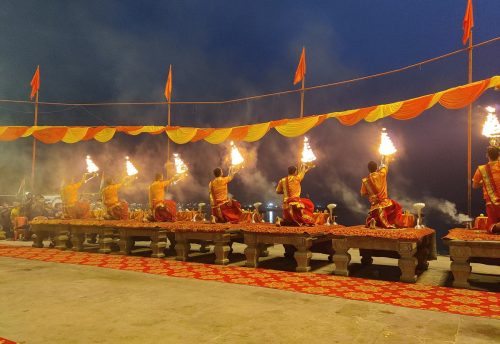
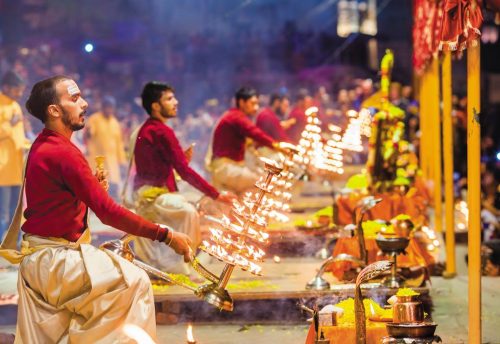
    Priests performing the Ganga Aarti on the Varanasi ghats at dusk

    Ganga Aarti at Dashashwamedh Ghat

    The ritual begins around dusk — roughly 5:45–6:00 PM in winter, 6:45–7:00 PM in summer — and runs about 45 minutes.

    Get to the ghat steps at least 45 minutes early if you want to sit rather than stand at the back.

Overnight in Varanasi. Book a hotel near the ghats or the Cantt area, so tomorrow's drive to Prayagraj does not start with a long trip across town — our own budget hotel near Assi Ghat is one option.

DAY2

Varanasi to Prayagraj: The Sangam and the City

Drive to Prayagraj after breakfast, then the Sangam and the landmarks scattered around the city.

  1. Morning
    The road out of Varanasi toward Prayagraj

    Drive from Varanasi to Prayagraj

    After breakfast and check-out, the drive to Prayagraj is about 130 km and takes roughly 2.5 to 3 hours. Prayagraj was known as Allahabad until 2018, and it sits at the Triveni Sangam, where the Ganga and Yamuna meet the mythical, invisible Saraswati.

  2. Late morning
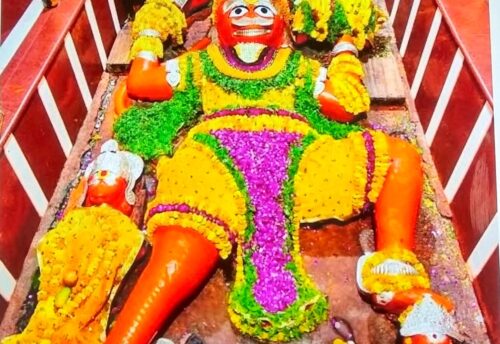
    The reclining Hanuman idol at the Lete Hanuman Mandir in Prayagraj, decorated with flowers

    Lete Hanuman Mandir

    A short stop near the Sangam, with an unusual reclining Hanuman idol said to be partly submerged each year when the Ganga rises in the monsoon. A calm, quick darshan before the boat ride out to the water.

  3. Midday
    Pilgrims and boats at the Triveni Sangam in Prayagraj during a Kumbh Mela

    Triveni Sangam: boat ride and a holy dip

    A dip at the confluence is the centrepiece of most visits to Prayagraj. Boats to the Sangam are hired on the spot at the ghat — agree the fare before boarding. Bring a change of clothes and a towel if you plan to bathe, and leave valuables at the hotel.

    If your dates line up with the Kumbh Mela or the smaller Magh Mela, expect the Sangam to be far more crowded than usual.

  4. Afternoon

    Anand Bhavan

    The Nehru family's ancestral home, now a museum on India's independence movement — worth the stop if that history interests you. Museums keep their own hours, so it is worth checking ahead if you are pressed for time.

  5. Afternoon

    Allahabad Fort

    Built by Akbar in 1583 beside the Sangam. Much of it is under military use today, so public access is limited to parts such as the Ashoka Pillar, the Saraswati Koop and the Patalpuri Temple, plus the Akshaya Vat, a sacred banyan tree believed to be indestructible.

    Which parts are open can change — confirm before you plan too much time around it.

  6. Evening

    Check in and rest in Prayagraj

    A full day of driving and sightseeing — settle in for the night. Dinner is easy to find near most hotels; there is no single spot you need to seek out here the way there is in Varanasi.

Overnight in Prayagraj. Pick a hotel reasonably close to the Sangam side of the city, so tomorrow's drive to Ayodhya does not start by crossing back through it.

DAY3

Prayagraj to Ayodhya: The Full Ram Mandir Darshan

Drive to Ayodhya, then Hanuman Garhi, the Ram Mandir, Kanak Bhawan and the evening aarti on the Saryu, all in one day.

  1. Morning

    Drive from Prayagraj to Ayodhya

    After breakfast and check-out, allow roughly four hours on the road, more if traffic is heavy. Leaving early gives you the rest of the day for the temples rather than rushing the Ram Mandir at the end of it.

  2. Afternoon
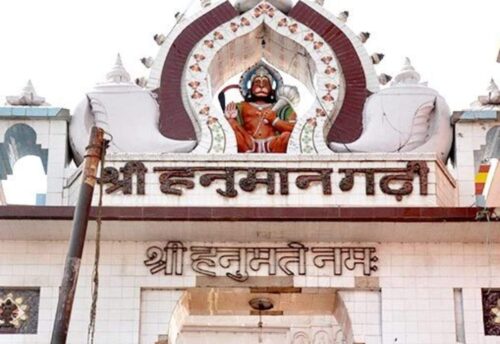
    The entrance gate of the Hanuman Garhi temple in Ayodhya

    Hanuman Garhi

    A hilltop temple to Hanuman, and by tradition the one visited before the Ram Mandir. A flight of steps leads up to it, so wear comfortable footwear.

    Tuesdays and Saturdays, Hanuman's days, are usually busier than the rest of the week.

  3. Afternoon
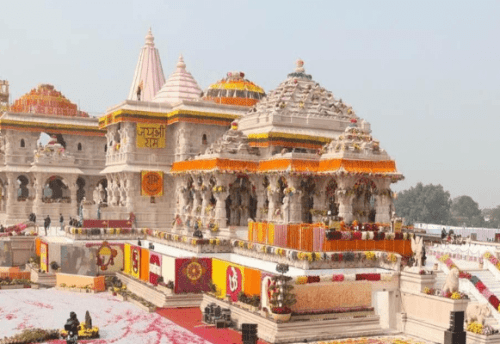
    The Ram Mandir in Ayodhya with its carved stone spires

    Ram Janmabhoomi Temple (Ram Mandir)

    The birthplace of Lord Rama and the reason most people come to Ayodhya, consecrated in January 2024. Security is strict — mobile phones, bags and similar items are generally not allowed inside, so travel light and wear modest clothing.

    Entry arrangements such as darshan slots and passes are set by the temple trust and change, so confirm the current rules for your dates.

  4. Late afternoon
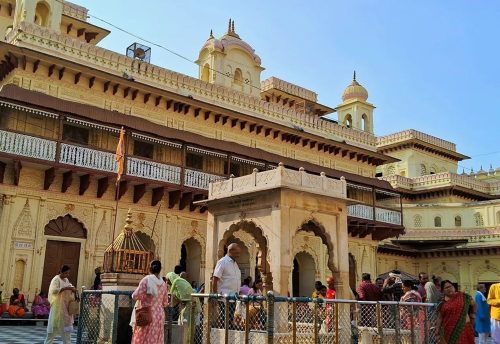
    The courtyard of the Kanak Bhawan temple in Ayodhya

    Kanak Bhawan

    Believed to have been gifted to Sita by Kaikeyi, and known for its richly adorned Ram–Sita idols. Temple hours change through the year, so we sequence this after the Ram Mandir rather than fixing a set time.

  5. Evening
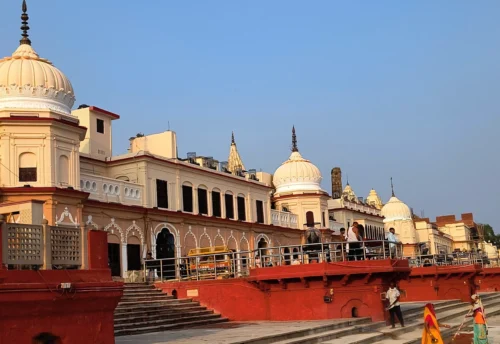
    The riverfront of the Saryu at Ayodhya with its ghats and temples

    Ram ki Paidi and the Saryu aarti

    A series of bathing ghats on the Saryu, and a peaceful place to close out a long day. The evening aarti here follows sunset, so its time shifts with the season.

Overnight in Ayodhya. Dasharath Mahal, Ramkatha Park and Guptar Ghat are worth adding here if the day has left you any time — none are essential, so treat them as extras rather than a fixed plan.

DAY4

Chhapaiya, Then the Long Drive to Naimisharanya

An early start for the Swaminarayan birthplace at Chhapaiya, followed by the longest drive on this itinerary.

  1. At first light

    Early start: Ayodhya to Chhapaiya

    With the Ram Mandir darshan already done yesterday, this morning is free for Chhapaiya, in Gonda district. Published distances disagree a little — the Gonda district tourism page gives about 35 km via Katra Parsurampur, other guides say 40 km — either way it is roughly an hour's drive from Ayodhya.

  2. Morning

    Shri Swaminarayan Mandir, Chhapaiya

    Chhapaiya, also written Chapaiya or Chapiya, is the birthplace of Bhagwan Swaminarayan, who was born here as Ghanshyam on 3 April 1781, and it remains a pilgrimage place for his followers worldwide. Ghanshyam Bhavan stands on the birthplace itself; the first temple here was built in 1863 by Acharya Ayodhyaprasadji Maharaj, a second followed in 1910, and the complex was renovated in the years up to 2016. Narayan Sarovar, where the young Ghanshyam is said to have bathed, lies just outside the temple complex.

    The mandir is listed as open roughly 5:00–10:30 AM and 3:00–8:00 PM, with a break at midday — that break is why this plan visits in the morning. Timings change, so confirm locally for your dates. This stop has no place guide or photos on our site yet.

  3. Late morning

    Drive on to Naimisharanya

    From Ayodhya, travel guides put the distance to Naimisharanya, in Sitapur district, at about 230 km, roughly 5 to 6 hours by the usual road through Sultanpur and Lucknow — the exact time from Chhapaiya itself depends on the route and traffic. This is the longest single stretch of driving on the whole trip, so build in a meal and a rest stop rather than pushing straight through.

  4. On arrival

    Check in and rest in Naimisharanya

    Naimisharanya, also spelled Naimisaranya or Neemsar, is a forest pilgrimage town on the Gomti river. You will likely arrive tired after a long day on the road — check in and save the sightseeing for a fresh start tomorrow morning.

Overnight in Naimisharanya. This is the longest day of the trip — if it sounds too rushed for your group, ask about spreading it over an extra night when you book.

DAY5

Naimisharanya & Your Drop at Lucknow

The sites tied to the Puranas in the morning, then the drive to Lucknow for your onward journey.

  1. Morning

    Chakra Tirtha

    The sacred wheel-shaped pond at the centre of Naimisharanya, believed to mark where the rim of Vishnu's discus touched the ground. It is the heart of the town and a good place to start, since the other sites sit close by.

  2. Morning

    Lalita Devi Temple

    One of the 51 Shakti Peethas and Naimisharanya's most important temple. Dress modestly, and expect larger crowds around Kartik Purnima and other significant dates on the Hindu calendar.

  3. Late morning

    Vyas Gaddi

    The seat associated with the sage Ved Vyas, traditionally linked to the compiling of the Puranas here. Hindu tradition holds that 88,000 rishis once gathered at Naimisharanya for a long yajna, during which the sage Suta Goswami narrated the Puranas — Chakra Tirtha, Lalita Devi and this spot are all tied to that story.

  4. If time allows

    Hanuman Garhi and Gomti Ghat

    Naimisharanya has its own Hanuman Garhi, distinct from the more famous one in Ayodhya, and Gomti Ghat, known for the small spiral Gomti Chakra stones found in its riverbed. Add either if the morning has left you time; neither is essential.

  5. Afternoon

    Drive to Lucknow and your drop

    Lucknow is about 90 km from Naimisharanya, roughly 2 to 2.5 hours by road, and is the usual gateway for onward travel — Chaudhary Charan Singh International Airport or a Lucknow railway station. Build in buffer time for traffic on the approach into the city.

    Returning to Varanasi by road instead is possible, but it is a much longer drive — plan for it in advance if you would rather end the trip there.

Trip ends with your drop at Lucknow airport or railway station.

For a careful read

Read the Full Varanasi, Prayagraj, Ayodhya, Chhapaiya and Naimisharanya Itinerary

Prefer to read it start to finish rather than scan the cards above? Here is the same plan as plain text.

This is the written version of the Varanasi Ayodhya Prayagraj Chhapaiya Naimisharanya 4 Nights 5 Days Itinerary, for anyone who would rather read every stop in order than scan the day cards above.


Day 1 in Detail: Old-City Temples & the Evening Aarti in Varanasi

Land, check in, and give the day to the three old-city temples before the river takes over in the evening.

1. Check in and get your bearings

On arrival

Whether you fly into Lal Bahadur Shastri Airport or arrive by train at Varanasi Junction or Manduadih, head straight to your hotel and drop your bags. With five places to cover in five days, this trip does not leave much room for a slow start.

2. Kal Bhairav Temple

Late morning

Local custom has visitors seek Kal Bhairav's blessing — he is considered the guardian of Kashi — before the other old-city temples. Open roughly 5:00 AM–1:30 PM and 4:30–9:30 PM; entry is free and 30–45 minutes is enough.

A cab only gets you to the edge of the lane — the last stretch to the shrine is on foot.

3. Kashi Vishwanath Temple

Late morning

The present temple was built in 1780 and is reached today through the Kashi Vishwanath Corridor, opened in December 2021. Phones and cameras are not allowed inside, so leave yours at the hotel or use a locker.

Budget 1.5–3 hours depending on the queue. Mondays and the month of Shravan are the busiest.

4. Annapurna Temple

Midday

A two-minute walk from Vishwanath. Published hours are roughly 4:00–11:30 AM and 7:00–11:00 PM, so it is closed for much of the afternoon — arriving here late morning avoids a second trip in the evening.

5. Rest, or a walk through Vishwanath Gali

Afternoon

Three temples on foot in old-city heat is enough for most people. Head back to the hotel, or browse Vishwanath Gali and the Godowlia market for Banarasi silk — there is no obligation to buy anything.

6. A boat ride before the aarti

Evening, optional

Not essential, but worth the extra if you have the time. Boats leave from ghats such as Assi, Dashashwamedh, Namo and Kedar, and watching the aarti from the water beats the crowded steps.

Agree the fare before boarding if you are hiring one on the spot, or book ahead through us.

7. Ganga Aarti at Dashashwamedh Ghat

Around dusk

The ritual begins around dusk — roughly 5:45–6:00 PM in winter, 6:45–7:00 PM in summer — and runs about 45 minutes.

Get to the ghat steps at least 45 minutes early if you want to sit rather than stand at the back.

Overnight in Varanasi. Book a hotel near the ghats or the Cantt area, so tomorrow's drive to Prayagraj does not start with a long trip across town — our own budget hotel near Assi Ghat is one option.


Day 2 in Detail: Varanasi to Prayagraj: The Sangam and the City

Drive to Prayagraj after breakfast, then the Sangam and the landmarks scattered around the city.

1. Drive from Varanasi to Prayagraj

Morning

After breakfast and check-out, the drive to Prayagraj is about 130 km and takes roughly 2.5 to 3 hours. Prayagraj was known as Allahabad until 2018, and it sits at the Triveni Sangam, where the Ganga and Yamuna meet the mythical, invisible Saraswati.

2. Lete Hanuman Mandir

Late morning

A short stop near the Sangam, with an unusual reclining Hanuman idol said to be partly submerged each year when the Ganga rises in the monsoon. A calm, quick darshan before the boat ride out to the water.

3. Triveni Sangam: boat ride and a holy dip

Midday

A dip at the confluence is the centrepiece of most visits to Prayagraj. Boats to the Sangam are hired on the spot at the ghat — agree the fare before boarding. Bring a change of clothes and a towel if you plan to bathe, and leave valuables at the hotel.

If your dates line up with the Kumbh Mela or the smaller Magh Mela, expect the Sangam to be far more crowded than usual.

4. Anand Bhavan

Afternoon

The Nehru family's ancestral home, now a museum on India's independence movement — worth the stop if that history interests you. Museums keep their own hours, so it is worth checking ahead if you are pressed for time.

5. Allahabad Fort

Afternoon

Built by Akbar in 1583 beside the Sangam. Much of it is under military use today, so public access is limited to parts such as the Ashoka Pillar, the Saraswati Koop and the Patalpuri Temple, plus the Akshaya Vat, a sacred banyan tree believed to be indestructible.

Which parts are open can change — confirm before you plan too much time around it.

6. Check in and rest in Prayagraj

Evening

A full day of driving and sightseeing — settle in for the night. Dinner is easy to find near most hotels; there is no single spot you need to seek out here the way there is in Varanasi.

Overnight in Prayagraj. Pick a hotel reasonably close to the Sangam side of the city, so tomorrow's drive to Ayodhya does not start by crossing back through it.


Day 3 in Detail: Prayagraj to Ayodhya: The Full Ram Mandir Darshan

Drive to Ayodhya, then Hanuman Garhi, the Ram Mandir, Kanak Bhawan and the evening aarti on the Saryu, all in one day.

1. Drive from Prayagraj to Ayodhya

Morning

After breakfast and check-out, allow roughly four hours on the road, more if traffic is heavy. Leaving early gives you the rest of the day for the temples rather than rushing the Ram Mandir at the end of it.

2. Hanuman Garhi

Afternoon

A hilltop temple to Hanuman, and by tradition the one visited before the Ram Mandir. A flight of steps leads up to it, so wear comfortable footwear.

Tuesdays and Saturdays, Hanuman's days, are usually busier than the rest of the week.

3. Ram Janmabhoomi Temple (Ram Mandir)

Afternoon

The birthplace of Lord Rama and the reason most people come to Ayodhya, consecrated in January 2024. Security is strict — mobile phones, bags and similar items are generally not allowed inside, so travel light and wear modest clothing.

Entry arrangements such as darshan slots and passes are set by the temple trust and change, so confirm the current rules for your dates.

4. Kanak Bhawan

Late afternoon

Believed to have been gifted to Sita by Kaikeyi, and known for its richly adorned Ram–Sita idols. Temple hours change through the year, so we sequence this after the Ram Mandir rather than fixing a set time.

5. Ram ki Paidi and the Saryu aarti

Evening

A series of bathing ghats on the Saryu, and a peaceful place to close out a long day. The evening aarti here follows sunset, so its time shifts with the season.

Overnight in Ayodhya. Dasharath Mahal, Ramkatha Park and Guptar Ghat are worth adding here if the day has left you any time — none are essential, so treat them as extras rather than a fixed plan.


Day 4 in Detail: Chhapaiya, Then the Long Drive to Naimisharanya

An early start for the Swaminarayan birthplace at Chhapaiya, followed by the longest drive on this itinerary.

1. Early start: Ayodhya to Chhapaiya

At first light

With the Ram Mandir darshan already done yesterday, this morning is free for Chhapaiya, in Gonda district. Published distances disagree a little — the Gonda district tourism page gives about 35 km via Katra Parsurampur, other guides say 40 km — either way it is roughly an hour's drive from Ayodhya.

2. Shri Swaminarayan Mandir, Chhapaiya

Morning

Chhapaiya, also written Chapaiya or Chapiya, is the birthplace of Bhagwan Swaminarayan, who was born here as Ghanshyam on 3 April 1781, and it remains a pilgrimage place for his followers worldwide. Ghanshyam Bhavan stands on the birthplace itself; the first temple here was built in 1863 by Acharya Ayodhyaprasadji Maharaj, a second followed in 1910, and the complex was renovated in the years up to 2016. Narayan Sarovar, where the young Ghanshyam is said to have bathed, lies just outside the temple complex.

The mandir is listed as open roughly 5:00–10:30 AM and 3:00–8:00 PM, with a break at midday — that break is why this plan visits in the morning. Timings change, so confirm locally for your dates. This stop has no place guide or photos on our site yet.

3. Drive on to Naimisharanya

Late morning

From Ayodhya, travel guides put the distance to Naimisharanya, in Sitapur district, at about 230 km, roughly 5 to 6 hours by the usual road through Sultanpur and Lucknow — the exact time from Chhapaiya itself depends on the route and traffic. This is the longest single stretch of driving on the whole trip, so build in a meal and a rest stop rather than pushing straight through.

4. Check in and rest in Naimisharanya

On arrival

Naimisharanya, also spelled Naimisaranya or Neemsar, is a forest pilgrimage town on the Gomti river. You will likely arrive tired after a long day on the road — check in and save the sightseeing for a fresh start tomorrow morning.

Overnight in Naimisharanya. This is the longest day of the trip — if it sounds too rushed for your group, ask about spreading it over an extra night when you book.


Day 5 in Detail: Naimisharanya & Your Drop at Lucknow

The sites tied to the Puranas in the morning, then the drive to Lucknow for your onward journey.

1. Chakra Tirtha

Morning

The sacred wheel-shaped pond at the centre of Naimisharanya, believed to mark where the rim of Vishnu's discus touched the ground. It is the heart of the town and a good place to start, since the other sites sit close by.

2. Lalita Devi Temple

Morning

One of the 51 Shakti Peethas and Naimisharanya's most important temple. Dress modestly, and expect larger crowds around Kartik Purnima and other significant dates on the Hindu calendar.

3. Vyas Gaddi

Late morning

The seat associated with the sage Ved Vyas, traditionally linked to the compiling of the Puranas here. Hindu tradition holds that 88,000 rishis once gathered at Naimisharanya for a long yajna, during which the sage Suta Goswami narrated the Puranas — Chakra Tirtha, Lalita Devi and this spot are all tied to that story.

4. Hanuman Garhi and Gomti Ghat

If time allows

Naimisharanya has its own Hanuman Garhi, distinct from the more famous one in Ayodhya, and Gomti Ghat, known for the small spiral Gomti Chakra stones found in its riverbed. Add either if the morning has left you time; neither is essential.

5. Drive to Lucknow and your drop

Afternoon

Lucknow is about 90 km from Naimisharanya, roughly 2 to 2.5 hours by road, and is the usual gateway for onward travel — Chaudhary Charan Singh International Airport or a Lucknow railway station. Build in buffer time for traffic on the approach into the city.

Returning to Varanasi by road instead is possible, but it is a much longer drive — plan for it in advance if you would rather end the trip there.

Trip ends with your drop at Lucknow airport or railway station.


Good to Know Before You Go

  • Day 4 is the longest day on the road — about 230 km and 5 to 6 hours from Ayodhya to Naimisharanya alone, with the Chhapaiya stop on top of that. Start at first light and plan a meal and rest stop.
  • Phones and cameras are generally not allowed inside the Ram Mandir security checks or Kashi Vishwanath — travel light on those two stops especially.
  • Dress modestly for every temple across all five days: shoulders and knees covered, and shoes that are easy to slip off.
  • Chhapaiya's distance and darshan hours come from a district tourism page and the mandir's own published timings, which do not fully agree with each other — confirm locally if your dates are tight.
  • This itinerary ends at Lucknow, about 90 km from Naimisharanya, not back in Varanasi — plan your onward flight or train from there unless you arrange a road return in advance.
  • Entry arrangements at the Ram Mandir — darshan slots and passes — are set by the temple trust and change, so check the current rules close to your travel dates.

Getting it right

Practical Tips for Your Varanasi, Prayagraj, Ayodhya, Chhapaiya and Naimisharanya Itinerary

Getting There

Fly into Lal Bahadur Shastri International Airport (VNS), or take a train to Varanasi Junction or Manduadih, to start this itinerary. It ends at Lucknow — Chaudhary Charan Singh International Airport or a Lucknow railway station — about 90 km from Naimisharanya.

Getting Around

Five places across five days, with one very long driving day, is far easier with a single vehicle for the whole route rather than arranging transport town by town. A hired car with driver from Varanasi removes that hassle.

What to Wear

Modest clothing for every temple on this route, comfortable footwear for ghat steps and the Hanuman Garhi climb, and a light layer for cooler evenings in winter.

Best Weather

October to February is the most comfortable season across all five places — cool mornings and evenings make the long Day 4 drive and the walking at the temples easier.

Fewer Crowds for Darshan

March to September is hotter and more humid, but the Ram Mandir, Kashi Vishwanath and the other temples on this route are far less crowded. If darshan matters more to you than sightseeing comfort, this window means shorter queues.

Know before you go

Places to Visit in Varanasi, Prayagraj, Ayodhya, Chhapaiya and Naimisharanya on This Itinerary

Full guides exist for the Varanasi stops below. Chhapaiya and Naimisharanya do not have their own place guides yet — Naimisharanya has a destination travel guide instead.

Prefer it done for you?

Or Book This as a Guided Varanasi, Prayagraj, Ayodhya, Chhapaiya and Naimisharanya Tour Package

Everything on this page — as a package with pick-up, a private vehicle, a hotel and a local team handling the plan. Message us your dates on WhatsApp and we take it from there.

  • Airport or station pick-up
  • Private vehicle
  • Hotel included

Quick answers

Varanasi Ayodhya Prayagraj Chhapaiya Naimisharanya 4 Nights 5 Days Itinerary: Frequently Asked Questions

Enough to see the essentials of all five places, but it is a full schedule with almost no slack, especially on Day 4, which is mostly a long drive. This is the same route behind our Varanasi Ayodhya Prayagraj Chhapaiya Naimisharanya 4 Nights 5 Days Tour Package, with a private vehicle and hotels handled for you.

Ready to Plan Your Varanasi, Prayagraj, Ayodhya, Chhapaiya and Naimisharanya Trip?

Message us your dates and the number of travellers — we'll help you plan it yourself, or run the whole thing for you.

Chat with our team